Chapter 25: The Education System
- from award-winning book: "Unbalanced: Memoir of an Immigrant Math Teacher"

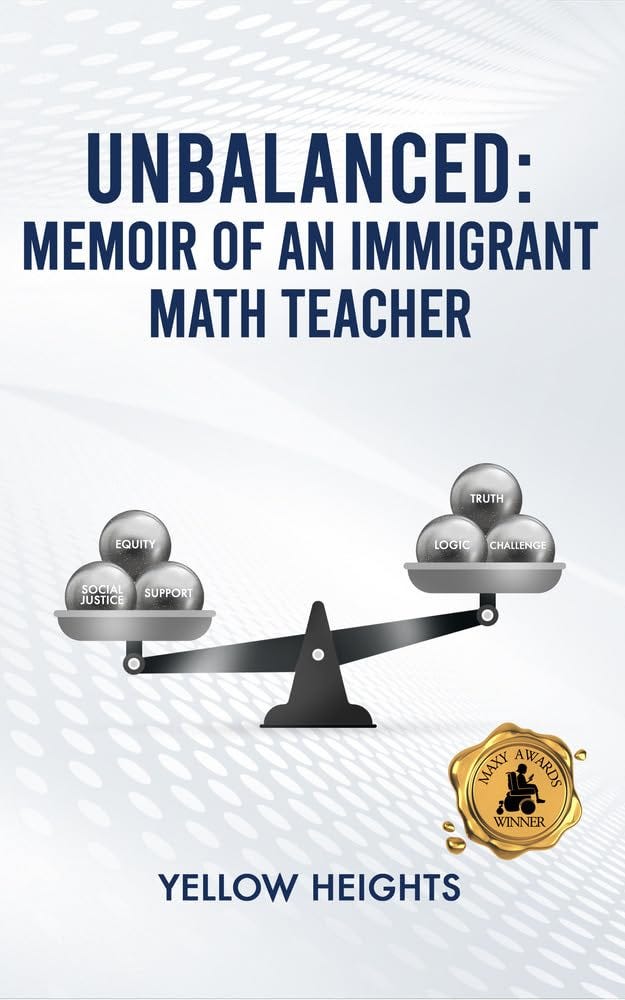
This is an excerpt from my recent book, “Unbalanced: Memoir of an Immigrant Math Teacher”. The title reflects my view that education has no magic solutions, that any virtuous idea could become harmful when carried too far. Specifically, there are three unbalances that need restoration:
First, the balance between accountability through quantitative metrics and wholistic education that emphasizes qualitative assessments.
Second, the balance between supporting students in need (especially those with diagnosed learning disabilities) and challenging students to develop grit.
Third, the balance between education’s social goals such as equity and emphasizing rigorous learning goals.
Idealists would say that we could do all, but in practice, the boundaries between those opposing forces are often drawn in less visible ways yet have significant ramifications. This chapter from the book discussed the third imbalance, how the quest for equity in education has compromised excellence.
—-
CHAPTER 45: THE EDUCATION SYSTEM
· The Political Influence in Education
The U.S. education system is highly decentralized, fragmented, and susceptible to political influence. While the federal government plays a role, public schools are regulated and funded primarily at the state and local level, with voter-elected school boards making operational decisions. The existence of over ten thousand school districts in the U.S. underscores the system’s fragmentation, lack of standardization, and resistance to top-down reform.
This complex structure has given rise to massive bureaucracies and systemic inefficiencies. As day-to-day administrators, school principals have limited power to make long-lasting decisions, and even public schools with long histories and academic traditions find it hard to control their own fate.
Lowell High School in San Francisco is one of the oldest public high schools in the U.S. and accepted students based purely on merits before the COVID pandemic. Its academic tradition was responsible for the extraordinary achievements of its graduates, including Nobel laureates and Supreme Court justices. During COVID, the school board changed its admission policy to a full lottery system and later voted to make it permanent.
A New Yorker article, “What Happens When an Elite High School Becomes Open for All,” depicted teachers’ heroic efforts to educate a drastically different student body amid limited resources and abrupt policy shifts. Reading it as a new teacher in a similar situation, I strongly resonated with the teachers’ profound sense of powerlessness.
This decision triggered widespread protests from parents and the alumni association, who sued the school district. Meanwhile, they organized the largest special election in the history of the San Francisco school district and successfully recalled three board members, ultimately restoring the admissions policy to what it had been before the pandemic.
Throughout this multi-year process, students were the biggest victims. The continuity and stability in learning that they most needed were severely disrupted by the political turmoil. In the first graduating class admitted by lottery, over 10% of students dropped out before graduation—more than twice the rate of previous years. Among those who remained, the average GPA fell from 3.69 to 3.45, and SAT scores declined by 78 points compared to prior years.
The Goals of Education
According to education scholar David Labaree, U.S. education has three social purposes: democratic citizenship, social efficiency, and social mobility.
Throughout much of the U.S. history, public schools have aimed to create relatively equal conditions for citizens through education access and a strong culture of civic commitment. The first purpose, democratic citizenship, remains especially important today through civics education and has the potential to unite the nation and combat increasing political polarization.
The second purpose of education, social efficiency, is to provide the economy with skilled workers. Economic needs for labor evolve over time, and education needs to keep pace. In today’s information age, when access to learning resources is widely available, education should evolve from imparting knowledge to teaching students how to think and learn for themselves. The looming AI age challenges education to fulfill the need to provide students with new skills, such as asking the right questions or judging answers from outside sources logically.
The third purpose of education, social mobility, is to prepare students to compete for social positions and realize individual dreams. Americans have generally equated fairness with social mobility, which is the very fabric of the American dream. This is related to meritocracy, which assumes that if opportunities can be awarded based on merit, a fair society can be achieved.
However, as opportunities became scarce, competition intensified, and education started to resemble a consumer product in the marketplace. Parents wanted the best for their children’s education and were willing to use their resources to get it for them. This resulted in good educational opportunities going disproportionately to students with more family resources and served to diminish social mobility achieved through education.
Through the power of education, which was increasingly influenced by students’ family backgrounds, economic stratification has become more extreme and rigid in recent decades. In 2023, the top 1% held 31.5% of total wealth in the U.S., while the bottom 50% held only 2.5%. The Federal Reserve Bank of Minneapolis (2021) reported that only 50% of individuals born in the 1980s earned more than their parents, compared to 90% of those born in the 1940s, indicating that the social mobility goal of education has regressed significantly.
The Quest for Social Justice
Throughout most of America’s history, the struggle for justice has centered on equal rights for women, people of color, and other disenfranchised groups, with significant progress achieved on this front. However, the quest to improve the condition of the worst-off members of society has faltered, resulting in economic and social inequalities unparalleled in U.S. history.
The term “equity” remains confusing to many, including certain Supreme Court justices. The dictionary defines equity as “the quality of being fair and impartial” or “justice according to natural law or right.” Here, “just” and “fair” generally align with John Rawls’s book A Theory of Justice, which asserts that members of society have equal rights, and inequality should only exist if it improves the situation of the worst-off members while offering equal opportunities to all.
In practice, equity is related to, but not the same as, equality. It can mean three things: equal treatment, equal outcomes, or equal opportunities.
Equal treatment is an important part of procedural justice but is often insufficient. For example, disabled students need special accommodations, and simply applying common sense judgment is inadequate.
Equal outcomes are rarely cited as an explicit objective of equity, as they are often associated with communism. However, as Thomas Sowell’s writings point out, the pursuit of vaguely defined “equity” often leads to policies aimed at equal outcomes, such as a quota system.
The concept of equal opportunity has widespread support, but its interpretations can vary. Before the 1954 Supreme Court decision on Brown v. Board of Education, educating students in segregated schools was considered “separate but equal.” Societal attitudes have since evolved, but the boundaries of equal opportunity are still being tested and reshaped by current events. For example, the 2023 Supreme Court decision on college admissions found the race-based affirmative action policies at Harvard and the University of North Carolina to be unlawful.
In response to increasing wealth disparity and its failure to achieve social mobility, education has embraced a fourth goal: equity and social justice. From this perspective, education is less about learning and more about using its power to allocate social access and opportunities to achieve distributive justice—correcting the inequalities created by social and market forces.
· Equity In Education
The focus on equity, written into the mission statements of many public (and some private) schools, deeply influences who gets hired, what programs are adopted, what learning standards are used, what and how to teach, and what behavior is rewarded and punished in schools.
In teacher hiring, subject competence is considered far less important than the full embrace of equity and social justice. Teachers are encouraged, sometimes required, to incorporate social justice into teaching materials and grading practices. Those who express views inconsistent with equity are criticized or even fired, while those espousing such views are publicly praised.
Such prominent focus on equity in education can have serious consequences. Education has a clear duty to contribute to a fair society. Even considering the differences in the interpretation of equity and social justice, the current distribution of wealth and privilege is an urgent issue that threatens to destabilize our society. However, education cannot address the larger forces behind inequity, as distributive justice must be achieved primarily through the economic and social systems that distribute rewards, not the education system.
In doing so, we are asking education to fix social and political problems that we are unwilling or unable to address through political action. Elevating equity to such a high-profile goal gives education a moral calling—one that can transform rational issues into moral ones, often at the expense of logical reasoning. While this creates urgency to change the status quo, it risks backfiring, if not accompanied by broader political and economic reforms.
First, it detracts from the goal of excellence. When equity overtakes as the top priority in education, individual excellence becomes de-emphasized, even stigmatized. This explains why some schools are removing learning differentiation and limiting access to advanced academic programs. It also contributes to the lack of accountability, or the wrong kind of accountability that focuses purely on reducing the achievement gap within the student body and sacrifices excellence.
Public school districts that have most actively pursued equity goals have experienced relatively steep declines in high school student achievement, including New York City, Los Angeles and Chicago. Seattle Public Schools—one of the nation’s most equity-focused districts—spends 30% more per student, yet its students’ proficiency levels remain 17 to 25 points lower across all subjects, compared to those in its neighboring, less progressive school district.
Second, some equity policies in education can produce more inequitable or less inclusive outcomes. The decline of education quality caused parents to flee public schools. Even Mr. Felix and Ms. Mira—both ULW (the college I went for an education degree) instructors and prominent advocates of social justice in education—have withdrawn their children from public schools for private school or homeschooling. Equity-focused school districts such as Los Angeles, Chicago and Seattle have all seen over 10% decline in the past decade, forcing school closures—a painful and disruptive process disproportionately harming disadvantaged students.
The decline in educational quality not only undermines excellence but also fails to advance equity as it deprives disadvantaged students of opportunities through excellence. Pathways for these students to pursue academic excellence through schools once existed, but when schools lower standards in the name of equity, these opportunities start to close off.
The lowering of learning standards in school forces students to seek alternatives outside the school system, such as afterschool tutoring and enrichment programs. According to the Afterschool Alliance, annual spending on these programs has ballooned to an estimated $23–25 billion in 2025, up from $5–7 billion two decades ago. This trend undermines equity because, unlike privileged students, those from disadvantaged backgrounds often cannot afford these programs.
Well-intentioned but ill-conceived education policies favoring underprivileged students often leave them unprepared for workplaces that offer no such accommodations. This occurs when educators, in the name of equity, lower expectations, give inflated grades, and provide excessive assistance—practices that do not reflect how the outside world operates.
Several friends at Microsoft shared similar stories: a member of their team had ADHD and received more than normal time for assignments while in school. However, such accommodations couldn’t be sustained in a workplace environment, eventually leading to dismissal or resignation after years of underperformance despite significant support from the company.
Diversity should include differences in life experiences and opinions, not just those related to identity. Ironically, the emphasis on narrowly defined diversity has resulted in a severe lack of diversity in social and political views within education. The ULW teacher candidates and the teachers I encountered at work represented a narrow band of our society’s spectrum of political and social perspectives, but as educators, they disproportionately influence the next generation.
Third, equity policies often contribute to student fragility by overemphasizing the needs of the vulnerable. Vulnerability and fragility have subtle differences: vulnerability is the state of being exposed to harm, while fragility is the quality of being easily broken. One is an inner attribute of a person, and the other is often externally caused.
While society has a responsibility to protect its vulnerable members, education also has a duty to make students less fragile. Given appropriate exposure, students can often grow out of their fragility, even vulnerability sometimes, by developing natural resistance and immunity. Shielding them from challenges deprives them of the opportunity to build that resilience.
Excessive fear of harming the vulnerable often leads to practices that increase the fragility of students. Under the culture of fragility, teachers are discouraged and afraid to challenge students with learning issues. They feel obligated to provide accommodation, often beyond what is officially required, to demonstrate kindness. The resulting excessive kindness often led to coddling and reinforced a culture of fragility, which became even harder to change.
Fragility can manifest in various ways. Statements such as “these words are ideologically violent,” which I often encountered at the ULW education school, can reinforce fragility and provoke disproportionate reactions to discomforting perspectives. Simplistic and strong views on sensitive issues can turn students into activists for perceived injustices, leading them to take uncompromising stances. They often appear belligerent and tough on the outside while remaining intellectually and emotionally fragile inside.
Fourth, the focus on equity leads to accountability issues. It not only contributes to a lack of accountability for student learning but also promotes the wrong kind of accountability. In 2023, the principal of Princeton High School was suddenly dismissed, prompting widespread protests from students and parents. This principal was not only highly dedicated and exceptionally skilled at community building, but he also placed strong emphasis on students’ academic achievement. The official reason given by the school district was unconvincing, and many parents believed the real reason was his failure to meet the district’s “equity” targets. The school board had expected him to narrow the achievement gap within the school, but he was unwilling to do so at the expense of high-achieving students’ performance.
Lastly, it threatens to erode the future competitiveness of our country. The nation’s quest for AI dominance critically depends on talents from STEM field and the current system is failing especially in this respect. In a March 2025 interview, investor Ray Dalio stated that while 1% of the U.S. workforce is world-leading and 10% is highly capable, 60% lack the basic reading and math skills required for modern manufacturing jobs—a view largely consistent with national assessment data.
For now, the U.S. talent base remains strong, primarily due to its ability to attract top talent from around the world. For example, more than 60% of the top math talents in the U.S. got their undergraduate degrees from abroad, and it is reasonable to believe that a large portion of the remainder finished their K-12 studies outside of the U.S. as well. Without a more robust K–12 education system, serious challenges are likely to emerge for us to compete with other nations—particularly in light of current trends in de-globalization and shifts in immigration policy.
—-
If you find this discussion interesting, please consider buying the eBook on Amazon to support me keep doing advocates for better education for all students.
There's the issue of deciding how much to help the students lagging behind with special needs, vs. how much to develop the potential of advanced students. Given limited resources, U.S. school systems generally choose to help the laggers more. But not super effectively either, as described in the article.
And so, the onus continues to be on the advanced students to seek advocates on their behalf. I was lucky to have met a few before college (although highly debatable that I could be considered a case with good ROI but that's a separate story)
This is such an interesting subject and this chapter is so enlightening! I have read a lot of your book to date and it is really good! It's not only super interesting, but well-written. I found myself drawn in! Thank you for putting this out -- it's an important subject that we need to be more and more aware of!! :D